Carrots are one of the easiest vegetables to say yes to: cheap, in every store all year, and ready to eat straight from the bag. Everyone calls carrots healthy, but healthy how? Does the baby-carrot bag give your kid the same thing as a whole carrot from the bin, and does cooking them help or hurt? The answers may change how you buy, cook and serve them.
Quick answer: Carrots are as healthy as their reputation, in more ways than people mention. Carrot nutrition starts with vitamin A (one medium carrot covers more than half a day’s worth for everyone at the table), then adds fiber, potassium, vitamin K and B6. Fresh, baby, cooked, frozen and canned carrots all count, so whichever form your family eats is a good one.123
Carrot nutrition: what one carrot does for your family
So what does one carrot actually do for your family? More than its 25 calories would suggest. A carrot is about 88% water, yet it brings a real share of six nutrients everyone at the table uses every day.1 The table shows how much one medium raw carrot gives (it’s roughly the length of a dollar bill), measured against the Daily Value on food labels.14
| Nutrient | One medium carrot | % Daily Value |
|---|---|---|
| Vitamin A | 509 mcg | 57% |
| Vitamin K | 8 mcg | 7% |
| Fiber | 1.7 g | 6% |
| Vitamin B6 | 0.08 mg | 5% |
| Potassium | 195 mg | 4% |
| Vitamin C | 3.6 mg | 4% |
Vitamin A is the standout by a wide margin, and one carrot goes a long way for everyone at the table, using the amounts the National Institutes of Health (NIH) recommends:12
| Who’s eating | One medium carrot covers |
|---|---|
| Toddlers (1 to 3) | more than a day and a half of vitamin A |
| Kids 4 to 8 | about a day and a quarter |
| Kids 9 to 13 | most of the day |
| Teens and adults | more than half the day |
Vitamin C is a small extra, since carrots aren’t a big vitamin C food. The other four make more sense once you see where they turn up in a day.
Picture an ordinary school day with a few carrot sticks packed for lunch. At lunch, vitamin B6 gets to work: NIH says the body needs it for more than 100 chemical reactions involved in metabolism, the behind-the-scenes chemistry of using food, and it plays a part in immune function.5 At recess, potassium is in every sprint and cartwheel, because the body relies on it for muscles to contract and nerves to send signals, as well as for the heart and kidneys.6 When a fall on the blacktop scrapes a knee, vitamin K helps the blood clot so the bleeding stops, and NIH notes it matters for healthy bones too.7 A carrot gives a little vitamin K; green leafy vegetables like spinach, kale and broccoli lead NIH’s list of vitamin K foods.7
All afternoon, fiber does its slower job. Insoluble fiber, a kind found in vegetables, adds bulk, and the National Library of Medicine says it seems to help food move along through the stomach and intestines.8 One carrot is a start on the day’s fiber, and beans, fruit and whole grains bring the rest.
Then comes bedtime. When the lights go off and your kid’s eyes adjust to the dark room, vitamin A is part of how that happens, and NIH says it also supports the immune system and normal growth: the growth you notice when last year’s jeans stop reaching their ankles.2 Carrots don’t hold vitamin A itself. They hold beta-carotene (BAY-tuh KAIR-uh-teen), the orange pigment that gives them their color, and the body turns it into vitamin A.2
All of these numbers are for one medium raw carrot. Most of us buy carrots in more than one form, though, so the next question is whether the bag, the freezer or the sheet pan changes any of it.
Which carrots to buy, and how to serve them
If you’ve wondered whether the bag of baby carrots is a shortcut that costs your kid something, it isn’t. The Dietary Guidelines count carrots as a vegetable in every form you’ll find in the store: fresh, frozen or canned, raw or cooked.3 Carrots are also in stores all year, and in USDA’s 2023 price data, whole fresh carrots averaged about 31 cents a cup, among the cheapest vegetables USDA priced.910 So the real choice is which form fits your week.
Baby carrots are mostly regular carrots, peeled, trimmed to about 1½ to 2 inches and bagged.9 The idea came from a California carrot farmer, Mike Yurosek, who in the mid-1980s got tired of throwing away bent and twisted carrots and started cutting them into 2-inch pieces.11 By weight, six baby carrots equal one medium carrot. They carry a bit less vitamin A, so it takes about seven to match one, and those seven still cover more than half a grown-up’s vitamin A for the day.1122
Here’s how the four forms you’ll find in most stores compare:
| Baby carrots | Whole carrots | Frozen | Canned | |
|---|---|---|---|---|
| Pros | Ready for the lunchbox, with no peeling or cutting. About 40 cents a cup in 2023.10 | The cheapest form, about 31 cents a cup.10 You can cut them into coins, sticks or shreds. | Already cut, and waiting in the freezer. Half a cup cooked has about 618 mcg of vitamin A, 69% of the Daily Value.134 | Already cooked, and it keeps in the pantry. Half a cup drained has about 407 mcg of vitamin A, 45% of the Daily Value.1442 |
| Cons | A little less vitamin A and potassium per bite than whole carrots.112 | Washing, trimming and cutting take a few minutes. | About 66 cents a cup, roughly double whole fresh carrots.10 | Less fiber than fresh. Regular cans add about 177 mg of sodium per half cup; no-salt-added cans have about 31 mg.1415 |
Raw or cooked? Cooked carrots hold on to their beta-carotene. In USDA’s numbers, a boiled carrot has about as much as a raw carrot of the same weight.116 Cooking may even help: NIH says cooking and heat can help the body absorb more beta-carotene from food.17 In a small 1998 study of eight women ages 23 to 36, four weeks of cooked, pureed carrots and spinach raised the beta-carotene in their blood about three times as much as the same amount eaten raw. The result wasn’t strong enough for the researchers to call it certain.18 A half-cup scoop of cooked carrot coins, about the size of half a baseball, has about 665 mcg of vitamin A, 74% of the Daily Value.16194
Raw carrots keep a little more vitamin C, and they have the crunch kids like with dip.116 For young children, cook them soft and cut them small, since CDC lists pieces of hard raw vegetables, raw carrots included, among choking risks.20
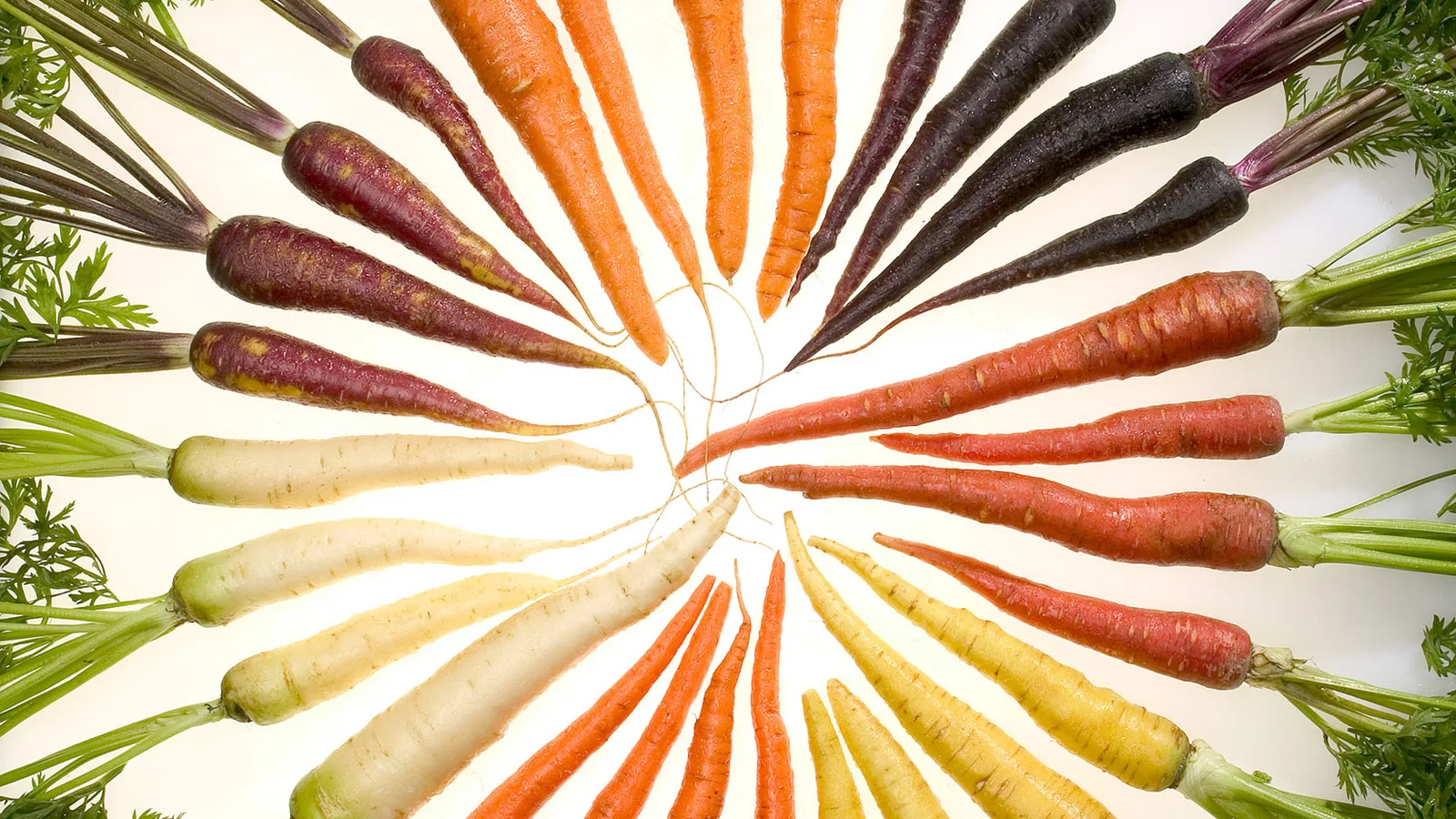
Orange, purple, yellow, red or white? You may spot purple, yellow or red carrots at the store or a farmers market, and each color comes from a different natural pigment. Dr. Philipp Simon, a carrot geneticist with the U.S. Department of Agriculture in Madison, Wisconsin, describes them this way:21
- Orange: mainly beta-carotene, with some alpha-carotene.
- Yellow: mainly xanthophylls (ZAN-thuh-fills), a type of carotene.
- Red: mainly lycopene (LIE-koh-peen), the red pigment in tomatoes, plus some beta- and alpha-carotene.
- Purple: anthocyanins (an-thoh-SIGH-uh-nins), a different family of pigments.
- White: none of these pigments, so no beta-carotene for the body to turn into vitamin A.
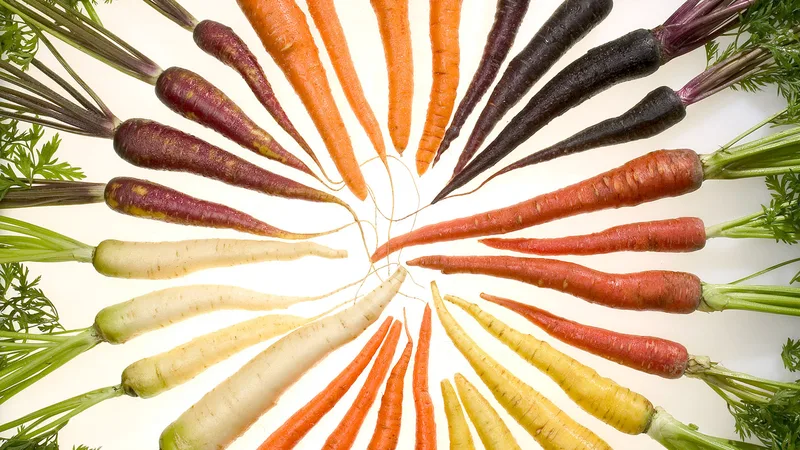
Photo: USDA Agricultural Research Service. Carrots bred in almost every color of the rainbow.
Put together: whole carrots cost the least, baby carrots save the prep, frozen ones save a busy night, and canned ones wait in the pantry. Buy the one your family will open. Roast or steam them when there’s time, and when canned is what you have, pick no-salt-added cans, which have about a sixth of the sodium.1415
Whatever form lands on the plate, a kid at the table may bring a question with it, usually one they heard at school: do carrots help you see in the dark?
Do carrots really help kids see in the dark?
Carrots do matter for your kid’s eyes, only not in the way the old saying promises. The myth also comes with a World War II story worth telling at dinner.
The true part. Vitamin A is a building block of rhodopsin (roe-DOP-sin), a light-sensing protein in the back of the eye.17 Without enough vitamin A, seeing in dim light gets hard, a problem called night blindness. NIH says that’s rare in the United States, because most people get enough vitamin A from food, and carrots are one of the foods it names.217
The myth part. What carrots can’t do is give healthy eyes extra night vision. Smithsonian Magazine put it plainly: “carrots can’t help the average person see better in the dark any more than eating blueberries will turn them blue.”22
How the myth started. In 1940, Britain’s Royal Air Force began using a new, secret radar to find German bombers at night. To keep the radar quiet, the British government gave newspapers another explanation for its pilots’ success: they ate lots of carrots. The star of the story was John Cunningham, a pilot nicknamed “Cat’s Eyes,” the first in Britain to shoot down an enemy plane with the new radar. Posters told the public that carrots would help them see during blackouts, and a cartoon character named Doctor Carrot, in a top hat and carrying a briefcase, promoted them.22 Historians still argue over whether any of it was meant to fool the Germans. A curator at the Royal Air Force Museum says Britain never set out to trick them and was simply happy to let the story spread.22
Our NutraPlanet News episode The WWII Carrot Lie That Fooled the World tells the story for kids. If your family likes a dinner question to chew on, try “would you keep a secret to help win a war?” Our free conversation starters have more food questions like that one.
Every one of those wartime posters showed an orange carrot. For most of carrot history, though, carrots weren’t orange at all, and that’s a fact worth handing to a curious kid.
How to make carrots something kids ask for
Here’s a fact to try on your kid at dinner: the first carrots people farmed weren’t orange. Carrots were first farmed in the Middle East and Central Asia, and the carrots grown in Central Asia about 1,100 years ago were purple and yellow. Orange carrots don’t show up in writing until the 1500s.23 You may have heard that Dutch farmers bred them orange to honor William of Orange. It’s a popular story with no records behind it, although Dutch growers did develop orange carrots around that time, largely because they grew well in the Netherlands.24 Here are a few ways to turn that curiosity into a carrot your kid wants to try.
Hold a roasted vs raw taste test
In our cafeterias, we served carrots roasted and as raw baby carrots with dip, and students took both about equally. They liked the crunch with dip and the sweetness of the roasted ones. That split makes a good contest at home. Roast half a batch until the edges brown, set out the other half raw with a dip, and let your kid cast the deciding vote.
Then let the winner earn a name. When Stanford researchers changed only the labels on vegetables in a university dining hall, students and staff picked them more often under indulgent names like “twisted citrus-glazed carrots”: 25% more people than under plain names, and 35% more than under healthy-sounding ones.25 Those diners were university students and staff. With kids, naming tonight’s batch gives yours a title to announce at the table.
Give them a carrot job
Try one of these jobs before the first bite:
- Sort the colors. If you find a bag of colored carrots, have your kid line them up and guess which pigment paints each one, using Dr. Simon’s list above.
- Count the lunchbox. Let your kid count baby carrots into everyone’s lunch bag: about 6 cover a day’s vitamin A for a 4 to 8 year old, about 9 for ages 9 to 13, and 10 to 13 for teens and adults.122
- Choose the bunch. At the store, let them pick the brightest, firmest carrots. For a kid who wants a bigger assignment, our free TJ’s Grocery Challenge and Taste Test Tracker adds a shopping quest and a chart for rating what they try.
- Scrub and shred. Older kids can scrub carrots and, with help, shred them for a salad or a wrap.
Along the way, ask what they notice: “Which one tastes sweeter, the roasted or the raw?” “Why would a carrot be purple?”
Watch and listen
For a carrot story on screen, watch our Adventures of Lil TJ episode The ONE Food That Stopped Him From Missing Everything together before dinner. While the carrots roast, put on one of these NutraBeats carrot songs.
Carrot Love (Smooth Soul Cover)
Carrot Wisdom
Orange Glow
Once carrots are a regular on your table, a few practical questions tend to come up.
Carrot questions
What vitamins are in carrots?
Vitamin A leads by far, coming from beta-carotene: one medium carrot has 57% of the Daily Value. Carrots also provide vitamins K and B6 and a little vitamin C, along with the mineral potassium and dietary fiber.14
Are carrots a superfood?
Harvard’s Nutrition Source says “superfood” has no scientific or regulated definition and works better as a sales word than as nutrition advice.26 Carrots earn their place without it: one medium carrot covers more than a young kid’s day of vitamin A for about 25 calories.12 Harvard suggests building a “super plate” of many different foods, and carrots are an easy, cheap part of one.26
Are carrots on the Dirty Dozen list?
No. Carrots are #13 on EWG’s 2026 Clean 15, the produce with the least pesticide residue in EWG’s analysis, and they aren’t on the 2026 Dirty Dozen.27 Regular carrots are a fine buy.
Can eating too many carrots turn your skin orange?
It can. NIH says eating a lot of beta-carotene can turn the skin yellow-orange, without naming an amount. Doctors call it carotenemia (kair-uh-tuh-NEE-mee-uh). It’s harmless, and it fades when you eat less of it. Beta-carotene from food doesn’t cause the problems that too much preformed vitamin A can.2 If you notice it, your pediatrician can confirm what it is.
Is it OK to eat carrots every day?
For most kids and adults, yes. NIH sets no upper limit for beta-carotene, the form of vitamin A in carrots, which means it hasn’t named an amount from food that’s too much; the main effect NIH names from eating a lot of it is the harmless skin tint above.2 Rotating carrots with other vegetables brings in the nutrients carrots are light on.
How do you store carrots?
Cut off the green tops first, since they pull moisture out of the root. Keep carrots in a plastic bag in the fridge’s crisper drawer, away from ripening fruit, which gives off a natural gas called ethylene that makes carrots spoil sooner. Montana State University Extension says they keep up to 2 weeks this way, and Utah State University Extension says a few weeks.928
Putting it to work this week
Carrots make the healthy choice the easy one. They’re cheap, in the store all year, and every form counts: raw sticks with dip in the lunchbox, roasted coins at dinner, frozen slices on a busy night. Each one brings a big share of the day’s vitamin A, plus fiber, potassium and a bit of vitamin K and B6. Let your kid run the roasted-vs-raw taste test with one of the three carrot songs playing, and save the World War II story from NutraPlanet News for dinner. When they want more, the Carrots issue of the NutraPlanet Gazette has the carrot rainbow, the farmer who invented baby carrots and a carrot-color taste test. Most issues give one food the star treatment like this. Read a free issue, and if it’s a hit, a Gazette library membership opens all 11 finished issues.
Every child is different, so if you have questions about what you or your kids should eat, your pediatrician or a registered dietitian is the best person to ask.
Footnotes
-
USDA FoodData Central: Carrots, raw ↩ ↩2 ↩3 ↩4 ↩5 ↩6 ↩7 ↩8 ↩9 ↩10
-
NIH Office of Dietary Supplements: Vitamin A and Carotenoids ↩ ↩2 ↩3 ↩4 ↩5 ↩6 ↩7 ↩8 ↩9 ↩10 ↩11
-
Dietary Guidelines for Americans, 2025-2030: Daily Servings ↩ ↩2
-
FDA: Daily Value on the Nutrition and Supplement Facts Labels ↩ ↩2 ↩3 ↩4 ↩5
-
USDA Economic Research Service: Fruit and Vegetable Prices ↩ ↩2 ↩3 ↩4
-
Santa Clarita Valley Historical Society: Michael Anthony Yurosek ↩
-
USDA FoodData Central: Carrots, frozen, cooked, boiled, drained, without salt ↩
-
USDA FoodData Central: Carrots, canned, regular pack, drained solids ↩ ↩2 ↩3
-
USDA FoodData Central: Carrots, canned, no salt added, drained solids ↩ ↩2
-
USDA FoodData Central: Carrots, cooked, boiled, drained, without salt ↩ ↩2 ↩3
-
NIH Office of Dietary Supplements: Vitamin A, Fact Sheet for Health Professionals ↩ ↩2 ↩3
-
Rock et al. 1998: Bioavailability of beta-carotene in raw vs processed carrots and spinach ↩
-
South Carolina DHEC: Take Charge of Your Plate! (serving sizes) ↩
-
USDA Agricultural Research Service: Philipp Simon, Carrot and Garlic Genetics ↩
-
Smithsonian Magazine: Carrots Can’t Help You See in the Dark ↩ ↩2 ↩3
-
NC State University News: Bugs Bunny’s Knowledge Confirmed (2016) ↩
-
Live Science: Are carrots orange because of a Dutch revolutionary? ↩
-
Turnwald et al. 2017: Indulgent descriptions and vegetable consumption ↩