Spinach sits at the top of the Dirty Dozen, so it makes sense to wash it hard: a long soak, a splash of vinegar, maybe a second rinse of the bag. Some of that helps, and some of it works against you. Here’s how to tell which is which before dinner.
Quick answer: Here’s how to wash spinach: rinse the leaves under cold running water, rubbing them gently, then dry them in a salad spinner or a clean towel. A gritty bunch gets a quick swish in a clean bowl first so the sand sinks, and a bag labeled ready-to-eat can skip all of it. Vinegar and baking soda are optional: in lab tests on spinach, both lowered pesticide residue, and extension services say vinegar also cuts some germs. The trade-offs are a soak, which CDC advises against for germs, and a pickled taste from vinegar.1234567
Bagged or bunch: does your spinach need a wash?
Turn the bag over before you turn on the tap, because the label may have done the washing for you. If the package says “ready to eat,” “triple washed” or “no washing necessary,” CDC says you don’t need to wash the greens, and the FDA says you can use them without another wash.21
That can feel backward, so here’s the reasoning. Those greens were already washed at the plant. A panel of produce-safety scientists looked at this question in 2007 and concluded that another wash isn’t likely to make bagged ready-to-eat salad safer, and that germs picked up from hands, sinks and cutting boards during that extra wash may outweigh any benefit.8 A Swedish lab test that copied home washing found the same limit from the other side: ordinary tap-water rinses didn’t significantly lower the E. coli on romaine leaves.9 If you like to rinse the bag anyway, the FDA’s advice is to keep the leaves away from any surface or utensil that isn’t clean.1
Everything else gets washed, and that includes organic spinach.10 That means:
- Bunches from the store or farmers market, roots and all
- Loose leaves from a bin or a salad bar-style display
- Spinach from your garden
- Bags or clamshells of baby spinach that don’t say ready to eat, triple washed or no washing necessary
If the bag question comes up on every grocery run, our free TJ’s Grocery Challenge gives the kids a list of finds to hunt down in the produce section, and checking the spinach label can be one of them.
If yours is a bunch, or a bag without one of those labels, four steps get it clean.
How to wash spinach, step by step
A bunch of spinach from the market or the garden usually brings a little of the field home with it, mostly sand tucked where the stems meet the leaves. The goal is to get that sand out without spreading germs between leaves. Start with clean hands: the FDA says to wash them with soap and warm water for at least 20 seconds before and after preparing produce.1 Then each step below does one part of the job.
- Trim and sort. For a bunch, cut off the root end so it falls apart into single leaves. For loose leaves, sort through them. Either way, toss any leaves that are torn, bruised or slimy. CDC recommends discarding torn and bruised leaves, and loose leaves give the water a way into every crease.2
- Swish only if it’s sandy. For a gritty bunch, fill a clean bowl with cold water, swish the leaves for about 30 seconds, and let the sand sink. Lift the leaves out with your hands rather than pouring the bowl into a colander, which would dump the sand right back on top. Repeat with fresh water until the bottom of the bowl stays clean. Clemson Extension uses the same 30-second swish, repeated until no grit is left.3 Keep it to a quick swish, never a soak: CDC advises against soaking greens in a sink or bowl, because germs on one leaf can spread through the water to the others.7 The bowl only drops the sand; the running water in the next step does the cleaning.
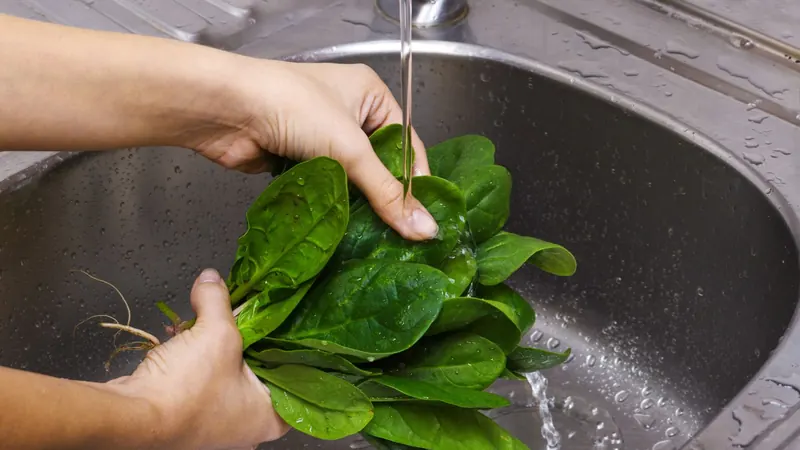
- Rinse under running water. Hold the leaves in a colander under cold running water and rub them gently with your hands. This is the step CDC recommends for every leafy green that isn’t labeled ready to eat.2 Cold water keeps the leaves crisp.
- Dry them well. Spin the leaves in a salad spinner or pat them with a clean cloth or paper towel. CDC and the FDA both list drying as part of the wash, and dry leaves keep longer in the fridge.21 Wash the spinner basket in warm, soapy water after each use, as University of Maine Extension advises.11
Skip the soap, dish detergent and store-bought produce wash. The FDA says soap and detergent can soak into produce even after a good rinse and can make you sick. Store-bought produce washes have a different problem: the FDA says the safety of what they leave behind isn’t known, and how well they work hasn’t been tested.1 When the University of Maine compared one brand of produce wash with distilled water, the two did about equally well on bacteria and pesticide residue, so the bottle mostly adds a cost.6 Plain running water is what both the FDA and CDC recommend, and it’s already at your sink.12
That clears the sand and rinses off some of the germs. What it can do about pesticides is the next question.
What washing can do about pesticides and germs
Spinach tops the Dirty Dozen, so it’s natural to want something stronger than water. EWG ranks spinach first on its 2026 list, with more pesticide residue by weight than any other fruit or vegetable tested.12 (Our Dirty Dozen guide explains the list and where organic money goes furthest.) Washing helps: EWG notes that washed produce carries less pesticide residue than unwashed produce, though no wash removes all of it.10 Germs work the same way. CDC says no washing method removes every germ, and it ranks cooked produce as the safest, with washed produce next.2
That’s where vinegar and baking soda come in. Both have real research behind them, and both come with a cost.
Vinegar. The sour part of vinegar is acetic acid (uh-SEE-tik), and the percentage on the label tells you how strong it is. Store vinegar has at least 4%, and most white vinegar labels say 5%.13 That number matters below, because the stronger the acid, the more pesticide it removed.
- What it does: University of Maine Extension describes a five-minute presoak in ½ cup distilled white vinegar to 2 cups water, followed by a clean-water rinse, and North Dakota State’s extension gives the same ratio. Both say it reduces bacteria without getting rid of all of them.116 On pesticides, a 2019 study in Pakistan sprayed spinach with four pesticides, then soaked it for 10 minutes. Acetic acid at 4%, close to store vinegar, removed about a third to a half of the residue. At 10%, twice the strength of store vinegar, it removed 70% to 94%.4
- The trade-offs: It means a soak, which CDC advises against for germs, and it can leave the leaves tasting a little like pickles. NDSU’s extension specialist says so outright, and Maine notes it can change the texture.6117
Baking soda.
- What it does: In a 2019 lab study in China, spinach treated with ten pesticides was soaked in a 2% baking soda solution, roughly a teaspoon per cup of water. After 15 minutes it removed about 37% to 74% of the residue, depending on the pesticide, while tap water removed about 8% to 32%. Soaking longer than 15 minutes didn’t remove any more.5
- The trade-offs: The test was done in a lab on spinach treated with pesticides, which may not match what’s on the spinach you buy. It needs a 15-minute soak, the same one CDC advises against for germs. We also found no test of baking soda against germs on leafy greens.57
So here’s how it fits together. For grit and germs, running water does the work. If pesticides are what’s on your mind, a vinegar or baking soda soak can lower them some, as long as every leaf still gets the running-water rinse afterward. Buying organic spinach, fresh or frozen, is the other way to lower residue.10 Washing berries? See how to wash strawberries to remove pesticides, where softer fruit changes the timing.
Clean spinach only helps if it’s still good on Thursday.
How to store spinach so it lasts
Washed spinach that turns slimy by Thursday usually went into the fridge a little wet. Water sitting on the leaves is what breaks them down, so the whole plan is about keeping them dry and cold. Get spinach into the fridge within two hours of bringing it home, or within one hour if it sat in a hot car, as CDC advises for leafy greens. Keep bagged spinach refrigerated too.21
There are two good ways to handle the wash, and the right one depends on your week.
| Option | Pros | Cons |
|---|---|---|
| Wash right before you use it | The leaves stay dry in the fridge, so they keep longest | Washing and drying happen on a busy night |
| Wash once for the week | Smoothies, eggs and quesadillas are ready in a minute | Only works if the leaves go in bone dry; any water left speeds up the slime |
If you wash right before cooking, keep the unwashed spinach in its bag or a container with a dry paper towel tucked in. If you wash ahead, spin the leaves twice, then store them loosely in a container lined with a dry paper towel, which soaks up the extra moisture. Leaves that turn slimy, smell sour or show mold go in the trash, and picking them out keeps them from spoiling the rest.
The wash itself, done together, is also the easiest way to get the whole family curious about spinach.
Make spinach easy to try, starting at the sink
If spinach hasn’t won over everyone at your table yet, the sink is a good place to start, because everyone gets their hands on it before anyone has to taste it. Each idea below lets the family get to know spinach first, with the tasting left for later and no pressure attached.
- Hunt for the sand. After the swish, have the kids tip the bowl and look at what settled on the bottom. It’s the most satisfying proof that the wash worked.
- Hand over the spinner. Pumping or pulling the salad spinner is a job a preschooler can do with a little help, and older kids can run the whole wash on their own.
- Tear the stems. Pulling leaves off thick stems is easy, a little noisy, and gets everyone touching spinach.
- Watch it shrink. Pile a big heap of washed leaves into a hot pan and let the kids guess how much will be left. By USDA’s weights, a cup of cooked spinach weighs about as much as six cups of raw leaves, so the heap really does shrink to about a sixth of its size.1415
- Add a handful to a favorite. Stir chopped cooked spinach into scrambled eggs for the toddler, fold it into a quesadilla for the school-age kids, and let the teen blend a handful into a smoothie. The flavor they already like does the introducing.
At the table, ask what everyone noticed (how much it shrank, how the raw leaves squeak, how the cooked ones turn dark green) instead of whether they like it. Every taste counts, even a small one.
The cooking goes faster with a song on. Our NutraBeats collection holds more than 400 kids’ food songs, and one of them was written for this pan. Play it while the leaves shrink:
Spinach Power Anthem
Once the spinach is washed and ready, it needs a dinner to land in. Our free Family Mealtime Toolkit has a 3-day meal plan and questions to ask at dinner, so the spinach has somewhere to go all week. For what all that spinach does for your family, and whether raw or cooked gives more, see spinach benefits for kids.
Once dinner is planned, a few practical washing questions still tend to come up at the sink.
Spinach washing questions
How long should you soak spinach?
For grit, a quick swish of about 30 seconds in a clean bowl is enough; repeat with fresh water until no sand settles.3 CDC advises against soaking leafy greens in a sink or bowl because germs can spread between leaves in the water.7 The pesticide studies above used 10- and 15-minute soaks, so if you choose one, finish under running water.45
Does cooking spinach kill bacteria?
Cooking is the safer step. CDC says the safest produce is cooked, and washed produce comes next, because no washing method removes every germ.2
Should you wash organic spinach?
Yes, unless the bag says ready to eat. The FDA’s advice to wash produce under running water covers all produce, and EWG says to wash organic and conventional produce alike.110
Can you freeze fresh spinach?
Yes, after a quick blanch. Clemson Extension says to wash the leaves, cut off woody stems, blanch them in boiling water for 2 minutes, then cool, drain and pack them, leaving ½ inch of space at the top of the container.16 Frozen spinach works best in cooked dishes like soups, eggs and pasta, or blended into smoothies.
Clean spinach, ready when you are
So the next time spinach comes home, read the bag first: ready-to-eat goes straight in the bowl, and everything else gets a quick swish to drop the sand, a rinse under running water and a spin dry. Let the kids hunt for the sand at the bottom of the bowl, hand them the spinner, and save a big handful for the pan so everyone can watch a heap of leaves shrink to a small pile. Put on “Spinach Power Anthem” while it cooks, and spinach night has its own soundtrack. When your family wants more food stories like that, the NutraPlanet Gazette gives a different food the star treatment in each of its issues. Start with a free issue, and when your family wants more, a Gazette library membership opens all 11 finished ones.
Every family is different, so if you have questions about what you or your kids should eat, your pediatrician or a registered dietitian is the best person to ask.
Footnotes
-
FDA: Selecting and Serving Produce Safely ↩ ↩2 ↩3 ↩4 ↩5 ↩6 ↩7 ↩8 ↩9
-
CDC: Listeria Outbreak Linked to Leafy Greens (consumer advice, updated 2024) ↩ ↩2 ↩3 ↩4 ↩5 ↩6 ↩7 ↩8 ↩9
-
Clemson Extension: Safe Handling of Lettuce & Leafy Green Salads ↩ ↩2 ↩3
-
Amir et al. 2019: Household chemicals and pesticide residues in spinach, Scientific Reports ↩ ↩2 ↩3
-
Wu et al. 2019: Home and commercial washing strategies for pesticide residues in spinach, kumquat and cucumber ↩ ↩2 ↩3 ↩4
-
NDSU Extension: What Is the Best Way to Clean Fresh Veggies? (2021) ↩ ↩2 ↩3 ↩4
-
CDC: Outbreak of E. coli Infections Linked to Leafy Greens (2020, archived) ↩ ↩2 ↩3 ↩4 ↩5
-
Palumbo et al. 2007: Recommendations for Handling Fresh-cut Leafy Green Salads, Food Protection Trends ↩
-
Uhlig et al. 2017: Household washing and E. coli on lettuce and ready-to-eat salads ↩
-
EWG’s 2026 Shopper’s Guide to Pesticides in Produce (summary) ↩ ↩2 ↩3 ↩4
-
University of Maine Extension: Preparing and Serving Fresh Garden Produce ↩ ↩2 ↩3