Spinach has had a strong reputation ever since Popeye first popped open a can. Families toss it into smoothies, pasta and eggs because everyone says it’s good for kids. The question is how much a little bit really does, and which way to serve it.
Quick answer: Spinach benefits for kids start with the three nutrients it’s richest in: vitamin K for blood clotting and bones, vitamin A for vision and growth, and folate for making new cells. Cooked spinach gives more per spoonful because it shrinks: half a cup covers a whole day of vitamin A for toddlers and kids up to 8. It has iron too, though the body absorbs less of it, so pair it with a vitamin C food.123456
Spinach benefits for kids: what it’s really known for
Spinach is famous for iron, but the nutrients it brings the most of are vitamin K, vitamin A and folate. Each one does a job your family counts on every day, and a small serving carries a lot of all three. All the amounts below are for cooked spinach, the kind stirred into sauces, eggs and soups.1
Vitamin K helps blood clot and keeps bones healthy, and NIH names spinach among the green leafy vegetables that supply it.2 That clotting is what closes up a paper cut from a school folder. Spinach carries so much of it that one tablespoon of cooked spinach, about 55 micrograms, covers a whole day for toddlers and kids up to 8, and about two tablespoons cover older kids, teens and adults.12
Vitamin A helps your family see normally, keeps the immune system working, and supports growing.3 Spinach doesn’t contain vitamin A itself. What it has is beta-carotene (BAY-tuh KAIR-uh-teen), hidden under all that dark green, which the body turns into vitamin A.3 Half a cup of cooked spinach has enough to cover a full day for toddlers and for kids 4 to 8, about three-quarters of the day for kids 9 to 13, about two-thirds for teen girls and women, and about half for teen boys and men.13
Folate is a B vitamin that helps the body make DNA and build new cells, which is busy work in a body that’s still growing.4 The same half cup of cooked spinach covers most of a toddler’s day, about two-thirds for kids 4 to 8, and about a third for teens and adults.14
Behind those three come a few smaller contributions. A cooked cup brings 37% of the Daily Value (the % figures printed on food labels) for magnesium, which NIH says the body uses for muscles and nerves, along with some vitamin C and fiber.178 Every one of those numbers is for cooked spinach, and that choice makes a bigger difference than most people expect.
Raw or cooked: which spinach gives more?
It’s easy to assume the raw leaves are the healthier ones, since cooking makes a whole bag of spinach shrink to almost nothing. The shrinking is the reason cooked spinach gives more. Put them on a scale and one cup of cooked spinach matches about six cups of raw leaves in USDA’s numbers, so every spoonful holds the nutrients of a big pile of fresh ones.91
| One cup of spinach | Raw (about 30 grams) | Cooked (about 180 grams) |
|---|---|---|
| Calories | 7 | 41 |
| Vitamin K | 121% of the Daily Value | 740% |
| Vitamin A | 16% | 105% |
| Folate | 15% | 66% |
| Iron | 5% | 36% |
| Magnesium | 6% | 37% |
| Vitamin C | 9% | 20% |
| Calcium | 2% | 19% |
Cooking does cost a little. Some heat-sensitive vitamins drop: by weight, USDA’s numbers for cooked spinach show about two-thirds less vitamin C and about a quarter less folate than raw, while vitamins K and A hold steady.91 So the choice comes down to what your week looks like:
- Raw spinach keeps the most vitamin C and takes no time at all: a handful goes into a smoothie, a sandwich or a salad. The trade-off is volume. The Dietary Guidelines count two cups of raw leafy greens as one cup of vegetables, so raw leaves add up slowly.10
- Cooked spinach packs the most vitamin K, vitamin A and folate into each bite, and soft, chopped spinach is easier for little kids to eat. The trade-off is the vitamin C lost along the way, and a few minutes at the stove.
Fresh, frozen and canned spinach all count as a dark-green vegetable in the Dietary Guidelines, cooked or raw.10 Frozen is an easy way to keep cooked spinach on hand. When UC Davis researchers compared fresh and frozen produce, spinach included, the frozen kind held its vitamins about as well as fresh overall.11 If your kids like a job at the store, our free TJ’s Grocery Challenge gives them things to track down, and spotting spinach three ways (fresh, frozen and canned) makes a good first mission.
Cooking doesn’t change one thing, though: how much of spinach’s iron the body can use. That’s where Popeye comes in.
Popeye, iron and calcium: the honest answer
Most of us grew up believing Popeye ate spinach for the iron, and it turns out his creator never said that. In a 1932 strip, the one time E.C. Segar had Popeye explain himself, the sailor says spinach is “full of Vitamin A.”12 Spinach’s beta-carotene becomes vitamin A in the body, so on that point, Popeye was right.123
So where did the iron reputation come from? You may have heard it was a misplaced decimal point, a lab typo that made spinach look ten times richer in iron than it is. That story turns out to be a myth too. Some early chemists did overmeasure spinach’s iron in the 1800s, most likely because iron from their lab equipment got into the samples, and the correct amount was published in 1892.1213
Spinach does have iron. Half a cup of cooked spinach has about 3 milligrams, 17% of the Daily Value.5 The catch is how much of it actually gets absorbed. NIH says spinach has low iron bioavailability (how much of a nutrient the body can absorb and use) because it contains compounds that block iron absorption, such as polyphenols (pol-ee-FEE-nols).5 Plant iron goes further when it shares a plate with vitamin C, and NIH names citrus fruits, strawberries, sweet peppers, tomatoes and broccoli as good partners.6 A few easy ones:
- Strawberries blended into the spinach smoothie
- Tomato sauce with spinach stirred into the pasta
- Red pepper strips next to a spinach quesadilla
- Orange slices on the side of spinach and eggs
That pairing matters especially for teen girls with heavy periods, whom NIH lists among the people more likely to run low on iron.6 Count spinach as one helpful source, alongside foods like meat, beans and fortified cereal, not as the family’s main one.
Calcium has a separate catch. Spinach contains oxalic acid (ox-AL-ik), which binds to calcium and keeps most of it from being absorbed. In a study of 13 healthy adults, about 5% of spinach’s calcium was absorbed, compared with about 28% from milk.1415 Calcium from broccoli, kale and cabbage is absorbed about as well as milk’s, and NIH notes that for people who eat a variety of foods, the oxalic acid in spinach probably has little effect overall.15 So enjoy spinach for its vitamins, and let milk, yogurt, cheese and other greens cover the calcium.
That’s the story for big kids and grown-ups. For the youngest eaters, a few things change.
Is spinach good for toddlers and babies?
Yes, and for toddlers the cooked kind is the easier place to start. Soft, finely chopped spinach mixes into foods they already eat, like scrambled eggs, pasta sauce, mashed potatoes or a smoothie, and CDC’s advice for little eaters is to prepare food to the right shape, size and texture for their stage, cutting it small or mashing it.16 Raw leaves are thin and chewy, so chopping cooked spinach fine makes it easier to manage.
A toddler doesn’t need much. One tablespoon of cooked spinach covers more than a full day of vitamin K for ages 1 to 3, and two tablespoons cover more than a third of their day’s vitamin A.123
For babies, the question is timing. The American Academy of Pediatrics advises avoiding foods with naturally occurring nitrates, spinach among them, before 3 months of age, because a baby that young can take in as much nitrate from them as from well water, and it notes that spinach baby food is commonly labeled not for babies under 3 months.17 The same report found little or no risk from store-bought baby food in the United States, though cases tied to home-prepared vegetable foods for infants still occur.18 Your pediatrician can tell you when and how to start spinach with your baby.
Once spinach is on everyone’s menu, the next step is getting everyone to try it.
How to make spinach easy to try
Spinach is easier to like once the kids have grown it, blended it or picked it out of the store bin themselves. These ideas give everyone a chance to meet spinach before anyone has to decide how they feel about eating it.
- Grow a pot of it. Spinach is a cool-weather crop that grows well in spring or fall. It can grow in a container, and it’s ready to pick in about 28 to 55 days from seed.1920 Kids can water it, count the leaves and pick the first ones themselves.
- Do the smoothie color reveal. Blend strawberries and a banana first, then let the kids drop in a handful of spinach and guess what color the smoothie will turn. The strawberries help the spinach’s iron, too.
- Run a leaf taste test. Put out tender baby spinach and larger flat leaves side by side, raw and cooked, and let everyone describe the difference: softer, crunchier, milder, stronger.
- Stir it into a favorite. A spoonful of chopped cooked spinach disappears into pancake batter, quesadillas or mac and cheese, and the flavor everyone already likes leads the way.
- Give it a Popeye name. Popeye Pasta, Sailor Smoothies, Muscle Muffins: let the kids name the dish, and it becomes their recipe.
When it reaches the table, swap “Do you like it?” for questions about what they saw: how much the spinach shrank, what color the smoothie turned, which leaf was softer. A single bite is a fine start.
While the Popeye Pasta cooks, let Popeye have the last word. Our NutraBeats library of more than 400 kids’ food songs has one that tells his side of the story. Play it while the pan sizzles:
Popeye Was Right
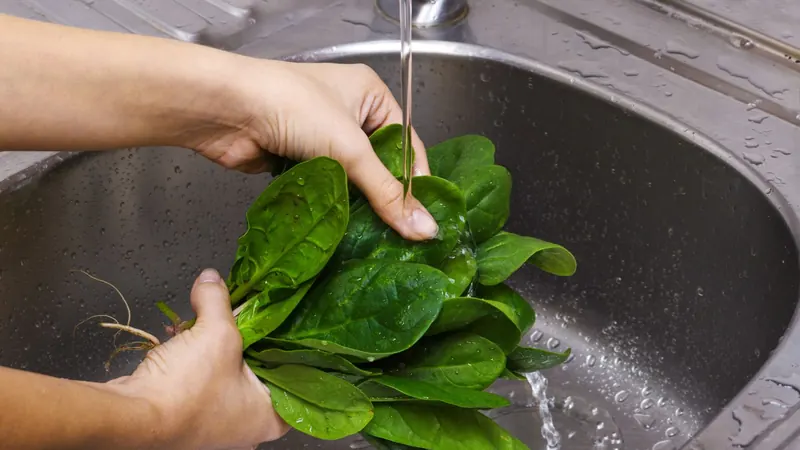
Once spinach has a place in the week, give it a few dinners. Our free Family Mealtime Toolkit comes with a 3-day meal plan and questions that get everyone talking at dinner. For washing the leaves before any of this, see how to wash spinach.
Before the next grocery run, a few last questions tend to come up.
Spinach questions families ask
How much spinach should kids eat?
There’s no set amount for spinach alone. The Dietary Guidelines’ eating patterns include about ½ cup to 2½ cups of dark-green vegetables a week, depending on how much food a person needs, from young children to active adults. Two cups of raw leafy greens count as one cup.10
Is frozen spinach as healthy as fresh?
Close to it: the UC Davis comparison, which included spinach, found frozen vitamin levels comparable to fresh overall, and the Dietary Guidelines count frozen spinach the same as fresh.1110 It’s an easy way to keep spinach on hand for cooking.
Is spinach a superfood?
“Superfood” has no official definition, so no food officially earns the title.21 By the numbers, a cooked cup of spinach carries more than seven times the Daily Value for vitamin K and a full day of vitamin A, which is why it keeps getting the nickname.17
Do the oxalates in spinach matter?
For most families eating a variety of foods, probably not: it mainly limits how much of spinach’s own calcium gets absorbed, as the Popeye section explains.15 People who have had calcium oxalate kidney stones are a different case: NIDDK lists spinach among the foods they may want to avoid and recommends talking with a health care professional about oxalate.22
Can someone on a blood thinner eat spinach?
That’s a question for their doctor. NIH says people taking the blood thinner warfarin (Coumadin) should keep the amount of vitamin K they get from food about the same every day, and a cooked cup of spinach has more than seven times the Daily Value.217
Popeye had a point
Popeye was right, only for a different reason than the one most of us remember. Spinach shines for vitamin K, vitamin A and folate, and cooking it packs more of all three into every bite. Put a vitamin C food on the same plate so the iron counts for more, and start a pot of spinach on the windowsill so the kids can watch dinner grow. Popeye had it right about vitamin A, and now your family knows the rest of his story. For more foods with a story like that, the NutraPlanet Gazette builds each issue around one food’s story. Start with a free issue, and if the kids want more, the Gazette library membership has all 11 finished issues waiting.
Every family is different, so if you have questions about what you or your kids should eat, your pediatrician or a registered dietitian is the best person to ask.
Footnotes
-
USDA FoodData Central: Spinach, cooked, boiled, drained ↩ ↩2 ↩3 ↩4 ↩5 ↩6 ↩7 ↩8 ↩9 ↩10 ↩11
-
NIH Office of Dietary Supplements: Vitamin A and Carotenoids ↩ ↩2 ↩3 ↩4 ↩5 ↩6
-
NIH Office of Dietary Supplements: Iron, for Health Professionals ↩ ↩2 ↩3
-
FDA: Daily Value on the Nutrition and Supplement Facts Labels ↩ ↩2 ↩3
-
Dietary Guidelines for Americans, 2020-2025, Appendix 3 ↩ ↩2 ↩3 ↩4
-
Bouzari et al. 2015: Vitamin retention in fresh and frozen fruits and vegetables (UC Davis) ↩ ↩2
-
Sutton 2016: How the spinach, Popeye and iron decimal point error myth was finally bust ↩ ↩2 ↩3
-
Heaney, Weaver and Recker 1988: Calcium absorbability from spinach ↩
-
NIH Office of Dietary Supplements: Calcium, for Health Professionals ↩ ↩2 ↩3
-
American Family Physician: AAP report on infant methemoglobinemia ↩
-
Greer and Shannon 2005: Infant methemoglobinemia, AAP clinical report ↩
-
University of Maryland Extension: Growing Spinach in a Home Garden ↩
-
Penn State Extension: Growing Spinach, a Cool-Season Vegetable ↩