If there’s a picky eater at your table, you’ve probably said it: “One bite, then you’re done.” It feels like the fair middle ground, and it’s one of the most common house rules around. So why do so many grown-ups still remember the one food they were made to eat as a kid, and still can’t stand it?
Quick answer: The one-bite rule can backfire with a picky eater because pushing a food tends to make kids eat less of it and like it less. Calm, repeated tries work better, and a try doesn’t have to be a bite: looking, touching, smelling or helping cook all count. Many kids need the food offered 8 to 15 times. Serve the new food next to one they already eat, at one family dinner.
Jump to: why one bite can backfire · what counts as a try · next foods to try · questions
Why one bite can backfire
Ask around the table at the next family gathering, and somebody will have a food they still can’t face: the canned peas, the liver and onions, the cold oatmeal they had to finish before they could go play. College students who were asked about it mostly had a story like that, and the most common one was a parent or teacher making a child eat a new or disliked food. Years later, about 7 in 10 said they still wouldn’t willingly eat that food.1
That doesn’t mean the parents in those stories were wrong to want their kids to try things. Trying really is how a new food becomes a familiar one, and “try some of everything” is a family rule in more than half of homes with kids ages 3 to 10.2 The trouble starts when the try becomes a test. Picture a group of preschoolers trying two new soups over several weeks: one served with nobody pushing, and one with a grown-up asking them to finish it. Over time they ate more of the soup nobody pushed, and said far more negative things about the one they were told to finish.3 A bite that somebody has to take turns the food into the thing standing between a kid and the end of dinner, and that’s the feeling that sticks.
So why is a new food such a big deal in the first place? A lot of it is built in. People are born disliking bitter tastes, possibly because so many bitter things in nature are harmful, and wariness of new foods may once have kept small children from eating something dangerous.4 It also runs in families: in a study of more than 5,000 pairs of twins, most of the difference between cautious kids and adventurous ones came from their genes.5 Some kids even taste bitterness more strongly than others, and it shows on the plate: preschoolers who were more sensitive to bitter tastes ate about half as many vegetables as the other kids, mostly passing on bitter ones like broccoli and olives.6 If your careful eater makes a face at broccoli that the rest of the table loves, their taste buds may be picking up a bitterness yours don’t.
Who’s eating matters too, which is how the same kid can eat bell peppers at a friend’s house and leave them on the plate at home. Little kids are more likely to eat a new food when the grown-up next to them is eating that same food,7 and preschoolers who watched a short video of other kids crunching on bell pepper ate more of it a week later.8 A friend’s plate, a cousin’s lunch, a parent going back for seconds: all of it tells a cautious kid that the food is safe. The good news is that this stage is common, and for many kids it eases with time.4
Here’s the surprising part. Researchers asked the families of more than 3,000 babies and toddlers a simple question: how many times do you offer a new food before you decide your child doesn’t like it? The most common answer was three to five. Yet many kids need a food offered 8 to 15 times before they accept it.9 So a lot of foods land on the “doesn’t like it” list right around the point they were about to start working. When kids in another study got a taste of red pepper on eight days over two weeks and were told they could eat as much as they liked, they ended up liking it more and eating more of it. Kids offered a sticker for eating a piece landed somewhere in between, and didn’t clearly beat doing nothing.10
If it feels like kids have always been this way, one historian would disagree. Helen Zoe Veit argues that a long picky stage is fairly new. In the 1800s, she says, American kids generally ate what their parents ate, children’s menus were half portions of the grown-up dishes, and parents rarely talked about making kids eat.1112 Kids came to dinner hungry, after a day of moving around with little snacking in between, and if you’d asked people back then which food children loved most, most would have said fruit.11 It’s a fun picture to keep in mind the next time someone says kids are “just like this”: a hungry kid at a table where everyone shares the same food is still one of the easiest places for a new food to get a fair chance.
So if a bite is only one kind of try, what else counts?
What counts as a try
“Don’t play with your food.” Most of us heard it growing up, and plenty of us have said it. When your kid pokes the broccoli, stacks the peas or sniffs a mushroom and sets it back down, it looks like stalling, the opposite of eating. Child-feeding researchers see it the other way around. Touching, smelling, playing with a food, even putting it in their mouth and taking it right back out, is how kids get to know a food before they’re ready to swallow it.4 The playing is the trying.
So can playing with food really move a kid closer to a bite? Researchers in England took that question to a nursery school. For four weeks, the toddlers there, all between 1 and 3 years old, spent part of every day with a pile of unusual fruits and vegetables. They looked at them, listened to them, felt them and smelled them. Nobody asked them to eat a thing. Then came mealtime. When those same vegetables showed up on the table, the toddlers touched them and tasted them more than vegetables they’d never played with.13
Preschoolers did the same thing after a play session with real fruits and vegetables. When the tasting plates came out, they tried more than kids who’d played with something else or only watched, and they even tried more of the foods that hadn’t been part of the play.14 A picture book can work this way too. Toddlers whose parents read them a book about an unfamiliar vegetable every day for two weeks went on to eat more of that vegetable than a similar one that wasn’t in the book.15 A look, a touch, a sniff and a story are all quieter tries than a bite, and they add up.
So the tries can start a long way from the plate. Pick one food that tends to sit untouched at your house, and give it a few of these this week. One note before you start: for kids under 4, cook vegetables soft, cut food into pieces no bigger than half an inch, and chop round foods like grapes and blueberries into tiny pieces.16
The mushroom sniff. Most of us only ever see the top of a mushroom. Flip one over and there’s a hidden world underneath: rows and rows of thin, papery gills fanned out like the pages of a tiny book. Hand everyone a mushroom and a mission: try to count the gills, give it a sniff (earthy, a little like the woods after rain), then tear it in half to see whether it’s the same color inside. Nobody has to taste a thing. At the table: slice a few into tonight’s pasta sauce and see who spots them first.
The broccoli forest. Look at a head of broccoli long enough and it turns into a tree. Snap off the florets and you’ve got a whole forest of little ones, a satisfying job for small hands. Stand them up on the cutting board, then roast half until the tips turn crispy and brown, like a forest in the fall. At the table: set a raw tree next to a roasted one and take a vote on which looks better.
The pepper hunt. A bell pepper is a lantern with a secret inside. Let your kid pick one at the store (red, yellow, orange or green) and carry it home. Cut off the top together and peek in: it’s hollow, with a little crown of seeds hanging from the ceiling. At the table: line up two colors and let the family vote on the prettiest.
The salad crew. Here’s a job almost anyone can do: tearing lettuce. It’s crunchy, it’s easy, and it might be the most useful kitchen job there is. When kids ages 6 to 10 helped a parent make lunch, they ate about three quarters more salad than kids whose parent cooked alone, and they said they felt more in control after cooking.17 At the table: whoever tore the lettuce gets to serve it.
The snap test. Some foods make their own sound effects. Snap a fresh green bean in half and listen for the crack. Break open a crisp sugar snap pea and find the little row of peas hiding inside. Bend a stalk of celery until it pops. Nobody has to eat a thing; the point is to hear it. At the table: serve the snappers cooked, and see who can still find the peas inside.
The strawberry detective. Hand each detective a strawberry and a magnifying glass (a phone camera zoomed all the way in works too). Those tiny specks on the outside are seeds, and counting them is harder than it looks. Find the leafy green cap, then slice the berry down the middle to reveal the pale heart inside. When the case is closed, build strawberry creatures with blueberries and banana coins (skip the toothpicks for little ones). At the table: the creatures sit next to a favorite, waiting to be noticed.
Even a good story counts. A food with a character, a song or a vegetable fun fact gives your kid something to tell about it before anyone asks them to eat it, and a mystery works too: the brownie game in our black bean recipes keeps a can of black beans hidden in plain sight until the big reveal.
A week of play with one food
Carrots make a good example of how a week of play adds up.
Monday: the bag comes home
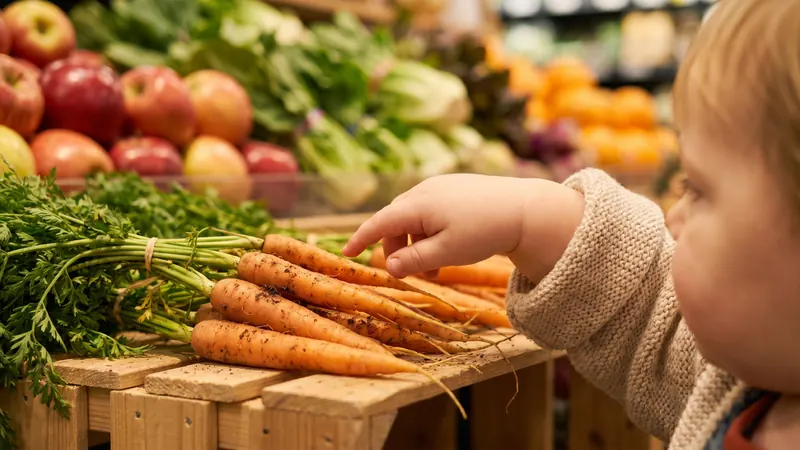
At the store, pick a bunch of carrots with the green tops still on, and let your kid carry it to the cart, then the car, then the fridge. Those feathery tops make a carrot look like something pulled straight out of the garden, because it was. It sounds too small to matter, but a new food feels a lot less risky once it’s familiar, and familiar starts with seeing it and holding it.13 By the time you’re home, the carrots aren’t strangers anymore.
Tuesday: the scrub
Hand your kid a vegetable brush and let them scrub the carrots under the faucet until the dirt washes away and the bright orange shows through. Older kids can take a turn with the peeler and watch the long orange curls pile up. It’s the same kind of hands-on play that got preschoolers tasting more of the foods they’d handled.14
Wednesday: the look inside
Slice a carrot straight across and look at the coin you’ve made: an inner circle and an outer ring, often in two slightly different shades of orange, like a tiny target. Cut another one the long way and see the core run from end to end like a stripe. Give it a sniff, too. It’s one more meeting where the carrot gets looked at, touched and smelled, the very things that had the nursery toddlers tasting more.13
Thursday: the stir
Tonight the carrot coins go onto a sheet pan with a little oil and salt, and your kid gets to toss them before they go in the oven, with you handling the hot parts. They come out soft, golden at the edges and sweeter than raw. Like the salad crew, your kid helped make them,17 so they’re their carrots on the table.
Friday: your turn
You eat the carrots at dinner, and you enjoy them. No speech, no “see, they’re good.” It’s the friend’s-plate effect from earlier, coming from you.7
Saturday: a seat on the plate
A few soft roasted carrot coins sit on your kid’s plate next to the mac and cheese, and nobody mentions them. Your kid has a full, familiar dinner to eat, so the carrots don’t have to prove anything. If they get poked, sniffed or eaten, great. If they sit there untouched, that still counts, and leaving them alone keeps the pressure off.3
What the week adds up to. On Monday, carrots were a stranger. By Saturday, your kid has carried them, scrubbed them, sliced them open, cooked them and watched you enjoy them: six meetings, and not one of them asked for a bite. Many kids need a new food offered 8 to 15 times before they accept it,9 so keep carrots going for another week or two and change how they show up: shredded into a slaw, grated into muffins, next to a favorite dip. By then the carrot is an old friend, and that’s when a first taste has its best chance.
If you’d like a week like that planned for you, pick a food in our free Meet-a-New-Food Planner and you’ll get a 7-day plan for it, with its story, a video, a song and a no-pressure taste, ready for the fridge.
Every age plays differently
Every age plays a little differently, and each one has its own reason to.
Toddlers and preschoolers
Little ones learn with their hands. Squishing a pea, stacking broccoli trees and sniffing a strawberry all look like messing around, but at this age that’s how a strange food becomes a familiar one, the same way the nursery-school toddlers got there.13 Expect mess, and count it as trying.
School-age kids
School-age kids want a real job and a reason to be curious. Give your kid the scrubbing, the tossing or the snap test, and let them be the one who explains the food to a younger brother or sister. A kid who helped make dinner tends to eat more of it,17 and a kid who gets to teach about a food has a reason to know it well.
Teens
Teens want a say in what they eat. Let your teen pick a new recipe, shop for it and cook it for everyone. The new food becomes their idea instead of a rule.
Grown-ups
Grown-ups are the ones everyone watches. When you try a new food, make a face because it isn’t your favorite yet, and then try it again next week anyway,7 your kid sees exactly what a try looks like: no drama, no rule, one more go. It might be the most useful thing they learn all week.
When the table gets curious, our free Conversation Starters keep it talking, with kid-friendly questions about the food on the plate and where it came from.
All those tries lead to one practical question: which food should come next?
A picky eater food list that starts with their favorites
You don’t need a list of the healthiest foods on earth. The best next food is usually a close relative of one your kid already eats. When young kids got to know two root vegetables through repeated tastes, they also ate more of a similar one they hadn’t been practicing with.18 Getting to know one food seems to make its look-alikes easier too.
The new food itself still does the real work. Across 30 studies of 2- to 5-year-olds, the approaches that offered a vegetable again and again worked better than the ones that didn’t, and plain vegetables did better than ones dressed up with a dip or sauce.19 A favorite dip can still help with that very first taste: preschoolers were three times more likely to pass on a vegetable served alone than one served with a dip they liked.20 So use the dip to get started, then let the plain food take over.
| If your kid already eats… | Try its relatives next | An easy first taste |
|---|---|---|
| Carrots | Parsnips, then sweet potatoes | Roasted carrot and parsnip coins, side by side (roasted soft and cut small for under 4) |
| French fries | Oven potato wedges, then sweet potato wedges | Wedges with their usual ketchup |
| Apples | Pears, then peaches | Thin pear slices next to apple slices (grated or cooked soft for under 4) |
| Green beans | Sugar snap peas, then asparagus | Cooked soft, with a favorite dip |
| Corn | Peas, then shelled edamame (smashed for under 4) | Peas stirred into buttered corn |
| Strawberries | Raspberries, then blueberries | A few on yogurt (chopped small for under 4) |
| Broccoli | Cauliflower, then Brussels sprouts | Roasted until the edges turn brown |
| Chicken nuggets | Homemade breaded chicken, then breaded fish | Same shape, same dip |
Where the next food sits
Once you’ve picked the next food, the only question left is where to put it, and the answer is right next to the foods your kid already loves. Pediatricians suggest serving new foods alongside familiar ones,21 and the pediatrician behind a 2024 national poll of parents recommends one family dinner with at least one food your kid usually eats.2 So build your kid’s plate mostly from favorites, then add a spoonful of the new food at the edge. Your kid still eats a good dinner. The new food isn’t the point of the plate, so there’s nothing riding on it. It sits there, picking up a try every night. And if a healthy kid doesn’t eat much one night, they’ll be more likely to eat at the next meal.2
When you’d rather not plan those plates from scratch, our free Family Mealtime Toolkit has a three-day family meal plan ready to go, with conversation starters for the table.
Every new food goes down easier with a soundtrack. Our NutraBeats catalog holds more than 400 food songs, and these three are all about trying new things:
Try It Twice
Try Something New (Pruébalo)
Slow Down Taste More
With the new food seated at the table, a few questions usually follow.
Questions families ask
Is this just a phase?
For a lot of kids, yes. Researchers in the Netherlands followed about 4,000 children from 18 months until they turned 6. At 18 months, about 1 in 4 were picky. At 3, it was still about 1 in 4. By 6, it was down to about 1 in 8.4 For some kids it lasts longer: in one group followed from age 2 to 11, about 4 in 10 of the kids who were picky stayed that way for more than two years, and their growth wasn’t affected.22 Calm, steady tries help either way.
Is my kid getting enough to eat?
Often more than it seems. Babies and toddlers whose parents called them picky still met their energy and nutrient needs on the day they were measured, the same as the others.9 Your pediatrician checks growth at every visit and can tell you whether your child is on track.
When should I worry?
Talk to your child’s doctor if the list of foods keeps getting shorter, if your child is losing weight or not growing, needs nutrition drinks to get by, eats only certain textures, seems afraid of choking, vomiting or pain when eating, or if eating gets in the way of school, family or friends. Those can be signs of avoidant/restrictive food intake disorder (ARFID), which is different from everyday caution about new foods.2324 See a clinician if any of this sounds familiar.
Should I still ask for one bite?
You can offer one, and that’s different from requiring one. “There’s a little on your plate if you want to try it” keeps the food available without making it a test. Pediatricians suggest staying calm, never forcing, and serving new foods alongside familiar ones.21 Kids who are pushed to eat tend to eat less,3 while freely offered tastes, day after day, raise liking.1025
Do rewards or dessert-for-veggies help?
Not as much as you’d hope. Remember the red pepper: a sticker for eating a piece didn’t clearly beat doing nothing, while free tastes raised liking.10 Pediatricians also suggest not using a favorite food as a reward.21 Dessert can simply be part of the meal or skipped on a given night, without being the prize for finishing the vegetables.
Should I hide vegetables in their food?
Hiding works for what it does. Preschoolers whose main dishes had puréed vegetables mixed in ate more vegetables over the day, and they rated the food as highly as the regular versions.26 The catch is that nobody learns to like a food they can’t see, so hidden vegetables and visible ones do different jobs. Our spinach recipes do both.
Do French kids really eat everything?
Not according to one study. When researchers compared young children in the UK and France, the UK kids scored as less picky and less wary of new foods.27 Every country has its careful eaters.
Let the bite wait
The bite can wait. This week, let a new food come along to the store, sit in the colander, get stirred into the pot and land in a small spoonful next to the mac and cheese. Count every look, sniff and poke as a try, and keep going past five. The night someone finally tastes it on their own, it won’t feel like a win you had to fight for. It’ll feel like dinner. Our free Gazette issue gives one food its own comic, story and songs, and the Gazette library has all 11 finished issues for the foods that come next. Put on “Slow Down Taste More” and let the table take its time.
Talk to your pediatrician or a registered dietitian about what’s right for your child.
Footnotes
-
C.S. Mott Children’s Hospital National Poll on Children’s Health (2024) ↩ ↩2 ↩3
-
Lam, Picky eating in children, Frontiers in Pediatrics, 2015 ↩ ↩2 ↩3 ↩4
-
Cooke, Haworth and Wardle, American Journal of Clinical Nutrition, 2007 ↩
-
Bell and Tepper, American Journal of Clinical Nutrition, 2006 ↩
-
Staiano and colleagues, Journal of Nutrition Education and Behavior, 2016 ↩
-
Carruth and colleagues, Journal of the American Dietetic Association, 2004 ↩ ↩2 ↩3
-
Wardle and colleagues, European Journal of Clinical Nutrition, 2003 ↩ ↩2 ↩3
-
WBUR On Point: Why are American children such picky eaters? (2026) ↩ ↩2
-
Institute for Family Studies: Picky Eaters: A Modern American Phenomenon (2026) ↩
-
Heath, Houston-Price and Kennedy, Frontiers in Psychology, 2014 ↩
-
American Academy of Pediatrics, HealthyChildren.org: Choking Prevention ↩
-
Savage and colleagues, Journal of the Academy of Nutrition and Dietetics, 2013 ↩
-
American Academy of Pediatrics, HealthyChildren.org: Preschool Food and Feeding ↩ ↩2 ↩3
-
Spill and colleagues, American Journal of Clinical Nutrition, 2011 ↩