Dinner talk can run dry fast after “how was school?” A good vegetable fact gets it going again, as long as the fact is true. Some of the most repeated ones aren’t, and catching them is half the fun.
Quick answer: The best vegetable fun facts are true ones you can check at the table. A potato is a stem, green beans and black beans are the same plant, most “yams” in U.S. stores are sweet potatoes, and a cucumber is about 95% water. Play them as a game of fact or fake, and let everyone look, sniff, touch or taste to prove each one.
Jump to: the 15 facts · the famous fakes · the game
What makes a vegetable fact stick
You’ve probably seen it happen. Someone shares a fun fact at dinner, somebody says “huh,” and the table moves right along to the weekend. The fact was true. It was even interesting. It never had a chance to become a conversation, because it arrived as a sentence and left as one.
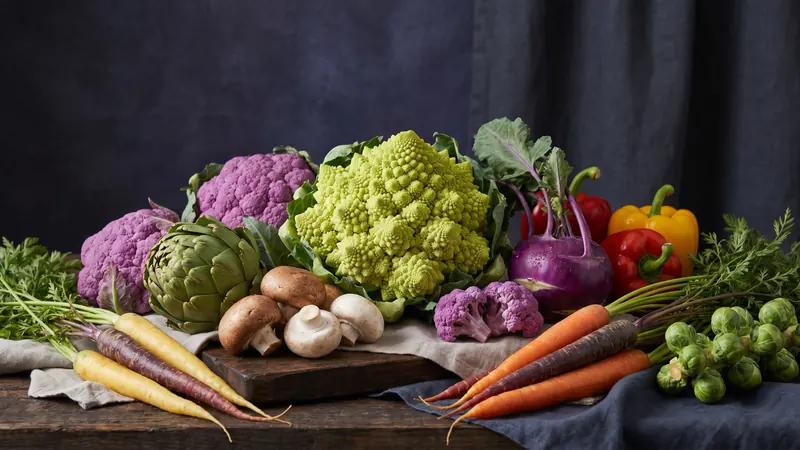
The facts that stick tend to have four things going for them:
- A surprise. It flips a thing everyone was sure about. “A tomato is a fruit” has been around so long that it barely registers. “The Supreme Court once ruled that a tomato is a vegetable” makes people put their forks down.
- A picture. You can see it in your head, or better, on the plate. A cauliflower that turned up orange in a field is easier to remember than the word “pigment.”
- An open question. The best facts leave a question hanging over the plate. If a potato is a stem, what’s a sweet potato? If mushrooms aren’t plants, what are they?
- A vegetable to hold. A fact about the green bean on your fork beats a fact about a vegetable nobody at the table has ever seen.
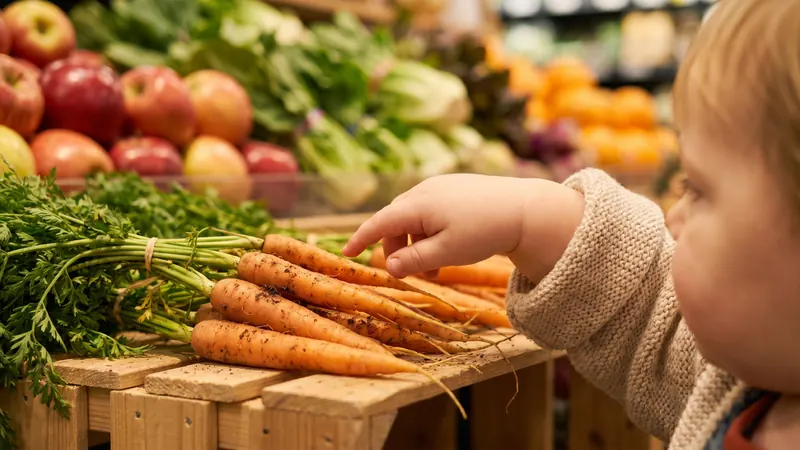
That last one matters more than it sounds. You might wonder whether a fun fact can really get anyone to try a vegetable. It can help. Preschoolers who learned about a vegetable that was new to them, a long white radish called mooli, were more likely to try some than children who didn’t get the lessons, and tasting it again and again over the weeks is what got them eating more of it.1 Toddlers who spent a few weeks looking at, feeling and smelling unusual fruits and vegetables in play touched and tasted more of those vegetables at a later meal.2 Curiosity does the inviting, and the vegetable in their hands helps with the rest.
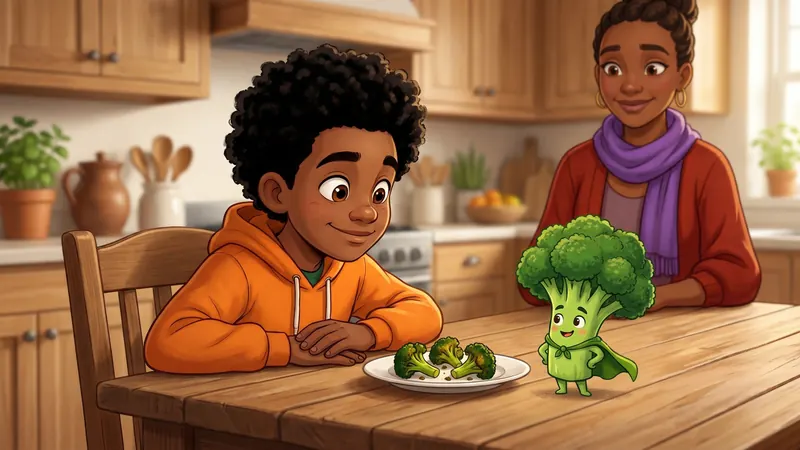
Older kids get curious too. When our Broccoli Gazette told the story of the U.S. president who wouldn’t eat broccoli, it got middle and high school students curious enough to look it up on the spot. The same fact can land very differently depending on who’s hearing it, which is where the telling comes in.
How to tell a fact so every age leans in
A fact that delights a 4-year-old can bore a 14-year-old, and the version a teen loves can sail right over a toddler’s head. The fact stays the same. What changes is the way you hand it over.
Little ones: put the fact in their hands
For the youngest at the table, the fact often works best as a job for their hands. Keep it to one short line, then give them a job that goes with it: count the eyes on a potato, find the seeds in a tomato, squeeze a cucumber slice and feel how wet it is. A silly picture helps too. “This potato has eyes” is an easier way in than the word “tuber.” Let them hold the vegetable while you talk, and count every poke, sniff and squeeze as part of the fun. For children under 4, cook vegetables until soft or chop them into tiny pieces, chop round, firm foods like grapes into tiny pieces too, and skip popcorn.3
School-age kids: make it a mystery they get to tell
Give school-age kids the fact as a riddle first, so they get to be the one who figures it out. “What do a green bean and a black bean have in common?” lets them guess before you reveal the answer. Then hand the fact over for keeps: tell them it’s theirs to try on a grandparent, a friend or a teacher tomorrow. The grosser, weirder or more backwards it sounds, the better it tends to travel.
Teens and grown-ups: tell the story behind it
For older kids and adults, the story behind the fact is usually the hook. Give them the history, the strange science or the argument: the family that took tomatoes all the way to the Supreme Court, the farmers who bred the bitterness out of Brussels sprouts, the World War II story that made everyone believe in carrot night vision. Then let them push back. Ask “do you buy it?” and let them look it up to check. A teen who proves a fact true, or catches one that’s fake, tends to own it.
With the whole table in mind, here are 15 facts worth telling, starting underground.
15 vegetable fun facts, from the roots up
Here’s a surprise to try on your family tonight: the vegetables on one plate can come from every part of a plant. In the kitchen, “vegetable” means a plant or plant part eaten with the main course rather than as dessert, which is how a root, a stem, a leaf and a flower bud can all land in the same salad.4 Sorted plant part by plant part, the facts turn dinner into a puzzle: which part of the plant is on your fork?
Roots
1. The first carrots people farmed weren’t orange. Picture a bunch of carrots in deep purple and sunny yellow, with not an orange one in sight. That’s what carrots looked like for hundreds of years. They were first farmed in Central Asia and the Middle East, and the oldest records, from roughly 1,100 years back, describe purple and yellow roots. Orange carrots don’t show up in the record until the 1500s.5 The bright orange stick in the lunchbox is the newcomer. At the table: ask everyone to guess what color the very first carrots were before you tell them.
2. Those “yams” are probably sweet potatoes. The orange “yams” piled high at Thanksgiving are almost always sweet potatoes going by a nickname. True yams are a completely different plant from Africa and Asia, with a tough, scaly skin, and some grow up to five feet long. The mix-up is so common that USDA requires sweet potatoes sold as “yams” to also be labeled “sweet potato,” so unless you go looking for real yams at an international market, a sweet potato is what you’re eating.6 At the table: send a school-age detective to check the sign or sticker on the next bag of “yams” at the store.
Stems
3. A potato is a stem, and it’s been to space. Pick up a potato and look at the little dents scattered across its skin. Those “eyes” are where new shoots sprout, which is why a bag forgotten in the pantry ends up covered in pale little sprouts. A potato isn’t a root at all. It’s a stem that swells up underground to store food for the plant, called a tuber. This stem has also traveled farther than most of us: University of Wisconsin-Madison Extension calls potatoes the first vegetable ever grown in space, with the growing technology developed by NASA.7 At the table: hand the youngest a potato and ask them to count its eyes, then ask everyone what a potato would pack for a trip to space.
4. Asparagus can grow almost 3 inches in a day. In spring, an asparagus field is practically a race. The spears push up out of the ground so fast you could almost check on them after lunch and see the difference by dinner. On a mild 60°F day, a 6-inch spear can grow about 2.7 inches, and how fast it goes depends on the spear’s size and the temperature.8 At the table: hold up a spear and measure out about 3 inches with your fingers. That’s one spring day of growing.
Leaves, buds and flower buds
5. Broccoli, cabbage, kale and cauliflower are one plant. They look nothing alike: a tight green tree, a heavy round head, a ruffled leaf, a white cloud. Yet broccoli, cabbage, kale, cauliflower, Brussels sprouts, kohlrabi and collard greens all belong to one species, Brassica oleracea. Over many generations, people kept the plants with the best leaves, buds, stems or flower clusters, and each line turned into a different vegetable. One plant biologist calls them “the dogs of the plant world”: one species, a lot of very different-looking breeds.9 Our post on broccoli benefits for kids covers what that one plant brings to dinner. At the table: line up a broccoli floret, a cauliflower floret and a cabbage leaf, and ask a teen to make the case for which “breed” is the family favorite.
6. Brussels sprouts taste milder than they used to. If a grown-up at your table remembers Brussels sprouts as bitter little cabbages, they’re not imagining it. In the early 1990s, scientists linked the bitter bite to natural compounds in the plant, and breeders went looking for milder ones to grow. One of the first milder Brussels sprouts went on sale in 1994, and even the “classic” sprouts aren’t as bitter as the old ones, one breeder says.10 At the table: roast a pan until the edges go crispy and brown, and ask the oldest person at the table whether they taste the way they remember.
7. An orange cauliflower once turned up in a field all on its own. Around 1970, a bright orange cauliflower was found growing in a Canadian field. It was making so much beta-carotene (BAY-tuh KAIR-uh-teen), which is the same orange pigment that colors carrots, that its normally white parts turned orange. Scientists have studied it to learn how plants switch that color on.11 At the table: set an orange cauliflower floret next to a carrot stick and let the little ones decide if they’re the same orange.
8. An artichoke is a flower bud that can make water taste sweet. The artichoke we eat is a flower bud that hasn’t opened yet. Leave it on the plant, and it opens into a big, bluish flower that looks like a thistle.12 It has a second trick, too: eating artichoke can make the next sip of plain water taste sweet, because it briefly changes how the tongue tastes.13 At the table: scrape the soft end of a cooked artichoke leaf with your teeth, take a sip of water, and see who notices the sweetness first.
Seeds and pods
9. Popcorn pops because of the water hiding inside. Every popcorn kernel holds a tiny drop of water in its center. Heat it fast, and the water turns to steam. The steam pushes harder and harder against the shell until the kernel bursts, and the soft inside puffs out into the fluffy white part you eat.14 At the table: pop a batch and look for the burst shell on each piece. Popcorn is a choking risk for children under 4, so little ones can watch and count the pops out loud instead.3
10. Green beans and black beans are the same plant. A crunchy green bean and a spoonful of black beans don’t seem to have much in common. They’re actually the same species, along with kidney beans, pinto beans and navy beans. Some are grown for the tender pods you eat young, which are green beans, and others are left to grow up so their seeds can be dried.15 Our posts on black bean health benefits and black bean recipes for kids pick up the story from there. At the table: snap open a green bean pod and let a school-age kid find the tiny beans inside.
Fruits in disguise
11. The Supreme Court ruled that a tomato is a vegetable. In 1893, a family that imported tomatoes took a tax on vegetables all the way to the U.S. Supreme Court, arguing that tomatoes are fruit. The justices agreed that botanically, tomatoes are fruits, along with cucumbers, squash, beans and peas. They ruled them vegetables anyway, because that’s how people cook and serve them: with dinner, not as dessert.16 At the table: cut a tomato in half, count the seeds, and let a teen argue the case for “fruit” or “vegetable.”
12. A green bell pepper is a pepper that was picked early. Like tomatoes, peppers are botanical fruits, full of seeds.4 Every bell pepper starts out green, then turns red, orange or yellow as it ripens. Most green peppers are picked before they get there, which is why they taste less sweet, and why they cost less. A few varieties do stay green when they’re ripe.17 At the table: taste a slice of green pepper and a slice of red one, and take a vote on which is sweeter.
13. A cucumber is about 95% water. That cool crunch has a reason: about 95% of a raw cucumber’s weight is water.18 In a way, every slice is a few sips of water that you get to chew. At the table: squeeze a few slices in a clean paper towel and see how wet it gets.
14. Squash is one of the oldest farmed crops found in the Americas. Squash seeds found in a cave in Oaxaca, Mexico, show that people were farming in the Americas about 10,000 years ago, and squash was one of the first things they grew.19 Squash has been on dinner tables for a very, very long time. At the table: scoop the seeds out of a squash and ask everyone to guess how old the oldest squash seeds ever found are.
Not even a plant
15. Mushrooms are closer to animals than to plants. They sit in the produce aisle next to the lettuce, but mushrooms aren’t plants at all. They’re fungi, and when scientists compared proteins from plants, animals and fungi, animals and fungi came out as each other’s closest relatives, with plants on a branch of their own.20 The mushroom on your pizza is, in a way, more your cousin than the spinach is. At the table: flip a mushroom over and look at the gills under the cap. No leaves, no roots, no seeds.
When the facts run out, the questions usually don’t. Our free Conversation Starters give the table a few more to ask about the food in front of you.
Now for the facts that trip up even the grown-ups.
The famous fakes
You’ve probably heard that carrots help you see in the dark. Some vegetable facts get repeated so often that nobody thinks to check them. They show up in books, trivia games and social media feeds, and that makes them hard to spot, even for grown-ups who’ve heard them for years.
Fake: Dutch farmers made carrots orange to honor their royal family. It’s a great story, and Dutch growers really did develop orange carrots in the 1500s and 1600s. There’s no record, though, that honoring William of Orange had anything to do with it.21 The true story, that the first farmed carrots were purple and yellow, is already strange enough.
Fake: carrots let you see in the dark. There’s a grain of truth in this one: carrots’ beta-carotene becomes vitamin A, and someone who isn’t getting enough vitamin A can have trouble seeing in dim light.22 For eyes that already get enough, extra carrots don’t add night vision. The legend took off in World War II, when Britain credited its night-flying pilots’ success to carrots to help keep its new radar a secret.23 Our carrot nutrition post tells the whole story.
Fake: spinach’s iron was a decimal-point typo. Plenty of us grew up hearing that a slipped decimal point once made spinach look ten times as iron-rich as it really is. The typo story turns out to be a myth of its own. Chemists in the 1800s really did overcount spinach’s iron, partly because iron from their equipment may have gotten into the samples, and a correct measurement came out in 1892.2425 Popeye’s side of it is in our post on spinach benefits for kids.
Fake: celery has “negative calories.” The idea is that chewing celery burns more calories than the celery holds. Even the lowest-calorie foods, celery included, have more calories than the body uses to digest them, and there’s no evidence any food works that way.26 A medium stalk has about 6 calories, and it’s still one of the crunchiest things you can dip in peanut butter.27
Now that you know the fakes, you can use them.
Fact or Fake: the game
Every fact and fake above can turn into a round. All you need is one vegetable on the table and someone to read.
- Pick the vegetable. Whatever is already in the fridge or on tonight’s plate works: a bell pepper, a potato, a handful of green beans, a few cauliflower florets.
- Read a fact as a question. “Fact or fake: a potato is really a stem?” Every few rounds, the host swaps in one of the famous fakes and keeps the answer to themselves until everyone has guessed.
- Everyone guesses. One point for each right answer. Wrong guesses are part of the fun, because they’re usually where the best “wait, really?” comes from.
- Prove it. Use the “at the table” idea for each fact. Anyone who looks, sniffs, touches or tastes gets a point for each one they choose, and nobody has to do any of them. A sniff counts as much as a bite. For children under 4, keep to soft-cooked vegetables or ones chopped into tiny pieces, and spread nut butter thinly.3
- Pass the host role. A teen or an older kid can run the next round, pick the vegetable and decide whether it’s a fact or a fake.
The game doesn’t have to stay at the dinner table, either:
- The grocery store hunt. Before the next trip, give everyone a mission: find a root, a stem, a leaf, a flower bud, a seed and a fruit in the produce section. Carrots, asparagus, spinach, artichokes, corn on the cob and peppers cover all six.
- Grow one on the windowsill. Set the cut top of a carrot in a shallow dish of water, and it sprouts feathery green leaves. The youngest at the table can check on it every morning.
- Make up a fake. Let one person invent a fake fact about tonight’s vegetable and see if anyone catches it.
If the table wants more to talk about, our free Family Mealtime Toolkit brings a three-day family meal plan and conversation starters for the table. To turn one new food into a whole week of small meetings, our free Meet-a-New-Food Planner can help, with a story, a song or an activity for each day.
The songs help, too. NutraBeats, our library of more than 400 food songs for kids, has one for the carrot round and one for the broccoli round:
Rainbow Roots
Forest on My Fork
Before your first round, here are answers to common questions about the game and the vegetables in it.
Questions about vegetable fun facts
How do I use fun facts to get my family to try vegetables?
Tie each fact to the vegetable on the table, then give everyone a small, easy way to check it: look, sniff, touch or taste. Learning about a new vegetable made preschoolers more willing to try it, and tasting it again and again is what got them eating more.1 Keep it a game with no pressure to eat, and count every look and sniff as a win.
What age are vegetable fun facts good for?
Every age at the table. Little ones get one short line and a hands-on job, like counting tomato seeds or watching the popcorn pop. School-age kids get the fact as a riddle and then get to tell it to someone else. Teens and grown-ups get the story behind it, and a teen makes a great host.
How often should we play?
As often as it’s fun. One fact on a weeknight is plenty, and the same vegetable can come back with a new fact another night. Getting to know a food takes many small, friendly meetings, so short and often tends to work better than one long round.
What if a fact doesn't spark much interest?
Pick a fact you can prove on the spot. “A cucumber is mostly water” gets more attention with a paper towel and a squeeze than as a sentence. You can also hand the next round to someone else and let them choose the vegetable and the fact.
How do I get teens into it?
Give them the story behind the fact, and put them in charge. Teens can host, invent the fakes, or look up a fact on the spot to prove someone wrong. The stranger the history, like the Supreme Court tomato case, the better it tends to go over.
Is a tomato a fruit or a vegetable?
Both, depending on who you ask. To a botanist, a tomato is a fruit, because it grows from the flower and holds the seeds. In the kitchen, and in an 1893 Supreme Court ruling, it’s a vegetable, because it’s served with dinner rather than as dessert.16
Is a potato a vegetable?
Yes. In the kitchen it’s a vegetable, and botanically it’s a stem, an underground storage stem called a tuber, not a root.7
Were carrots really purple?
Yes. The oldest records of farmed carrots, from Central Asia and the Middle East roughly 1,100 years back, describe purple and yellow roots. Orange ones turned up around the 1500s.5
Every vegetable has a story
A vegetable with a story gets talked about, and a vegetable that gets talked about gets picked up, sniffed and tasted. That’s the whole game: one fact, one guess, one chance to prove it, at any table and with any vegetable in the fridge. Cue up “Rainbow Roots” or “Forest on My Fork” for the carrot and broccoli rounds. When your family is ready for more food stories, start with our free Gazette issue, and the Gazette library has all 11 finished issues waiting.
Footnotes
-
Nekitsing and colleagues 2019: Taste exposure and nutrition education with an unfamiliar vegetable in preschool children ↩ ↩2
-
Dazeley and Houston-Price 2015: A nursery intervention with fruits’ and vegetables’ non-taste sensory properties ↩
-
American Academy of Pediatrics, HealthyChildren.org: Choking Prevention ↩ ↩2 ↩3
-
Washington State University Extension: Fruit or Vegetable? It’s Complicated ↩ ↩2
-
University of Illinois Extension: What’s the Difference Between Sweet Potatoes and Yams? ↩
-
University of Wisconsin-Madison Extension: Harvest of the Month, Potatoes ↩ ↩2
-
Purdue Vegetable Crops Hotline: Asparagus Harvest and Grading ↩
-
Live Science: Are kale, broccoli and Brussels sprouts really all the same plant? ↩
-
USDA Agricultural Research Service: Orange Cauliflower May Help Crop Scientists Boost Nutrition ↩
-
Bartoshuk and colleagues 1972: Sweet taste of water induced by artichoke ↩
-
University of Illinois Extension: Bright colors of bell peppers ↩
-
Baldauf and Palmer 1993: Animals and fungi are each other’s closest relatives ↩
-
Live Science: Are carrots orange because of a Dutch revolutionary? ↩
-
NIH Office of Dietary Supplements: Vitamin A, fact sheet for consumers ↩
-
Smithsonian Magazine: Carrots Can’t Help You See in the Dark ↩
-
Sutton 2016: How the spinach, Popeye and iron decimal point error myth was finally bust ↩
-
The Conversation: Can food have negative calories? A nutritionist debunks the idea ↩